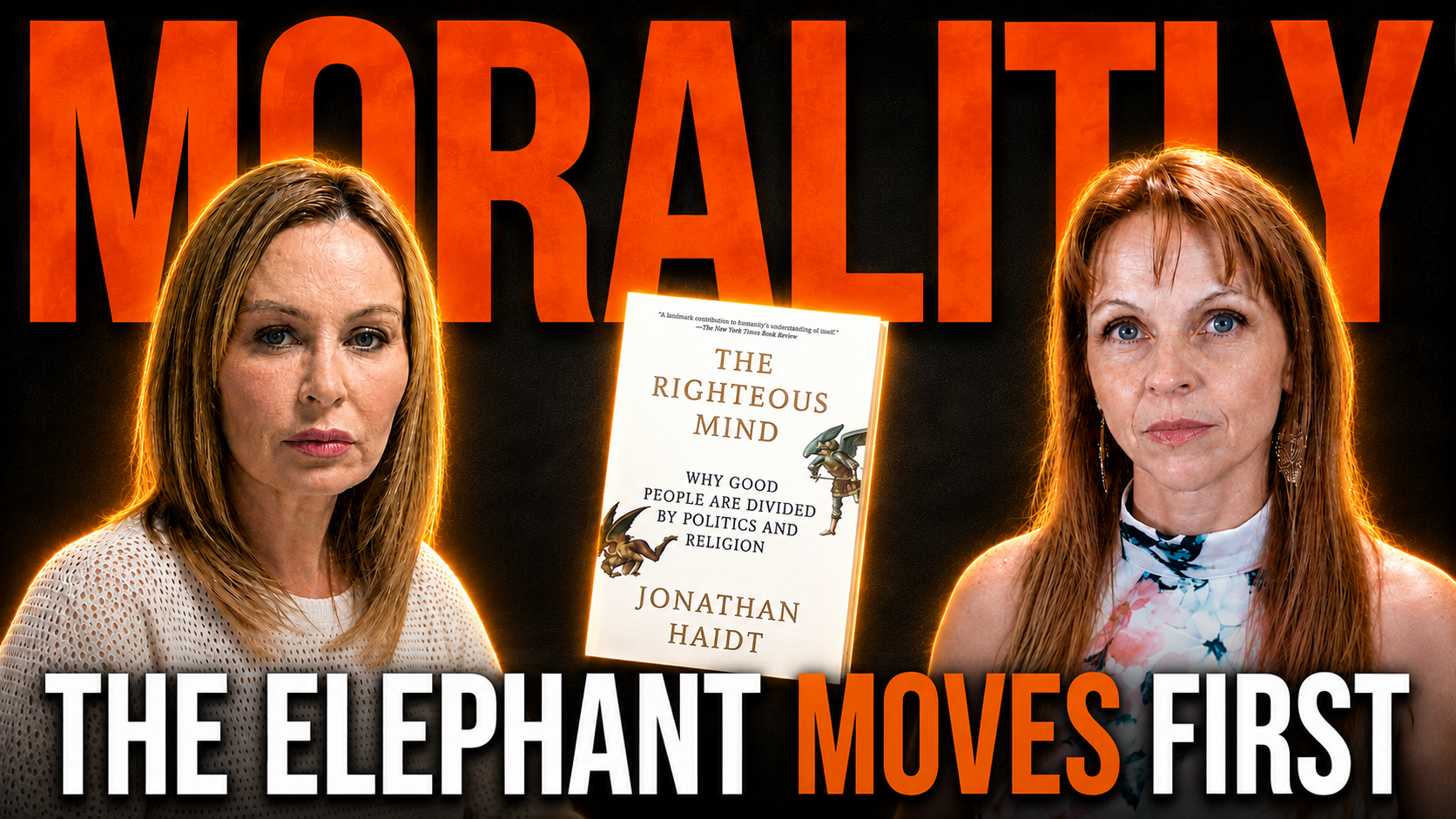
Episode 04 Part 1In which everyone thinks they're the reasonable one (spoiler: they are not)
We humbly request patience and understanding with any errors or areas needing improvement. We are still learning and finding our groove.If you like what you hear, please subscribe wherever you get your podcasts, watch, follow, and share.
A note on links to books: Every book we discuss is linked to bookshop.org. We love buying books from this site because all profits go to your chosen local bookstore. If shopping in a brick and mortar establishment is not an option, please consider purchasing via this site.
-
-
This two part episode breaks down why good people arrive at radically different moral conclusions, and why that matters even more in today’s political climate. Jamie and Mel use Jonathan Haidt’s framework to explain the elephant and rider, moral foundations theory, and hive psychology, then test those ideas against current politics, social media, and their own lived experiences.
The conversation is both analytical and personal, with Mel and Jamie each sharing moments of belief change shaped by religion, nationalism, and political reality. It’s a rigorous but candid discussion of morality, group identity, and why disagreement so often feels existential.
Key topics
In this episode, Mel and Jamie introduce Jonathan Haidt’s The Righteous Mind and explain why they split the book into two parts because it is dense and highly annotated.
They walk through Haidt’s core claim that moral judgment starts with intuition, not reasoning, using the elephant and rider metaphor to show that the “writer” usually just justifies what the elephant already decided.
They discuss confirmation bias, social media echo chambers, and how algorithms reward content that reinforces existing beliefs rather than challenges them.
Jamie connects the book to her own departure from the Mormon church, describing how defending a belief system can feel like defending your identity, morality, and community all at once.
Mel shares a parallel experience of learning history differently in another country and later realizing she had been exposed to propaganda, which reshaped how she thinks about belief and resistance.
They explain Haidt’s moral foundations theory, covering care, fairness, loyalty, authority, sanctity, and liberty, and how liberals and conservatives tend to prioritize them differently.
They argue that modern conservatism often functions as a kind of moral monism, with loyalty elevated above the other foundations, especially loyalty to a single leader.
They analyze immigration, government trust, and political identity as examples of how the same event can be interpreted through different moral foundations.
They move into Plato’s Allegory of the Cave as a second lens for understanding why people resist ideas that threaten their worldview.
The episode closes with a critique of Haidt’s framework, noting that understanding a moral system is not the same as endorsing it, and that some disagreements are really conflicts of interest, not misunderstandings.
-